techUK's AI Adoption Coalition Forum: Reflections on the future of work

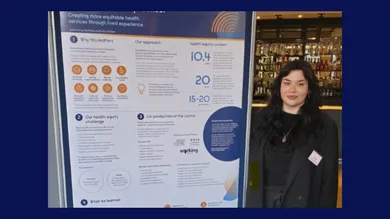
Recently I attended techUK’s inaugural AI Adoption Coalition Forum, which brought together leaders from across the tech sector to look at what responsible AI adoption looks like in practice and what is still holding organisations back. I attended in my role leading digital transformation at Reed in Partnership, where we are exploring how AI can support the realisation of better public services while keeping people at the heart of delivery.
The Coalition was launched to help accelerate meaningful AI adoption across the UK economy, with a focus on sharing good practice, identifying common barriers and developing practical solutions. The first forum focused on the digital and technology sector, with contributions from Katie Gallagher OBE, the sector’s AI Champion, and organisations including Arm, Salesforce, Tata Consultancy Services and AutogenAI.
Three key takeaways came out of the discussion.
AI adoption is becoming an organisational challenge, not just a technology challenge
Skills are frequently cited as one of the biggest barriers to wider AI adoption. But the discussion reinforced that this is about more than technical expertise.
Organisations also need leaders and managers who can identify where AI can genuinely add value, decide which tasks should be automated or augmented, redesign workflows and judge where human oversight remains essential.
That means AI adoption cannot be treated simply as the deployment of a new tool. The harder part is changing how work is organised around it.
For leaders, the challenge is increasingly about how to design organisations in which people and AI work effectively together, rather than how quickly new technology can be introduced.
For me, that points to a people-focused approach to AI: starting with the work people do, the decisions they make and the outcomes organisations are trying to achieve, rather than with the technology itself. It’s a principle that has shaped much of Reed in Partnership’s own approach. As we've explored opportunities to use AI across public services, the focus has been on how technology can support colleagues to deliver better outcomes, and how AI can create more capacity for meaningful human interaction.
We need a broader definition of ‘AI skills’
There is an understandable tendency to think of AI skills in terms of prompting, automation or familiarity with particular tools, but those capabilities are only part of the picture.
As AI takes on more analysis, drafting and recommendation, the human role changes with it. Judgement, critical thinking, analytical reasoning, communication and contextual understanding become more important because people still need to decide whether an AI-generated output is right, appropriate and useful.
That wider definition of AI capability is particularly relevant in public services, where professional judgement and human relationships remain critical.
This applies at every level of an organisation. Leaders need to understand where AI should sit within processes and decision making, while employees need the confidence and judgement to challenge its outputs rather than simply accept them.
The skills conversation therefore needs to move beyond learning how to use AI tools and towards learning how to work well alongside them.
AI is more likely to reshape jobs than simply replace them
Much of the debate around AI and employment still focuses on the number of jobs that may disappear. The discussion at the forum pointed towards a more useful question: how will the content of jobs change?
AI is already able to perform parts of many roles. That does not necessarily mean the role disappears. Instead, the balance shifts between what technology can do and where human contribution adds most value. Judgement, empathy, contextual understanding and the ability to deal with ambiguity may become more important precisely because AI can take on more routine analytical and administrative tasks.
There is also a risk on the other side of that equation. If people become too dependent on AI to retrieve information, analyse options or recommend decisions, some of the skills needed to exercise effective judgement could begin to weaken. Responsible adoption therefore needs to think not only about building new AI capabilities, but about preserving the human capabilities that allow people to challenge, interpret and use AI well.
For employers, the challenge is not only around adopting AI but thinking carefully about the jobs and skills that sit around it.
As AI adoption moves from experimentation into everyday use, these workforce questions will become harder to separate from the technology itself. The organisations that make the most of AI are likely to be those that keep people at the centre of adoption, thinking carefully about roles, judgement, skills and ways of working rather than focusing on the tools alone.